
By Boo Kok Chuon
A will may be formally valid in every respect, properly executed, correctly witnessed, and unambiguous in its dispositive intent, and still be fundamentally defective. Not because of drafting error, but because of a prior question that was never asked: did the testator actually own, in law and in equity, the assets purported to be bequeathed?
This question is not answered by a will-drafting tool. It is not answered by any AI-generated template. And it is increasingly not answered by testators who believe that legal title and beneficial ownership are one and the same thing.
They are not.
The Proliferation of DIY Testamentary Instruments
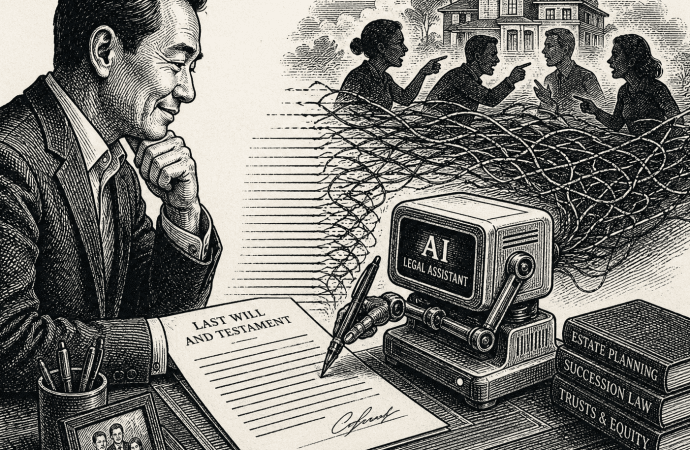
The accessibility of generative AI has created a class of legally compliant but substantively incomplete wills. A testator can produce, in minutes, a document that satisfies the formal requirements of the Wills Act 1838. It will recite assets with precision. It will nominate executors and beneficiaries. It will be signed and witnessed correctly.
What it will not do is interrogate the beneficial ownership of the assets it purports to distribute.
That interrogation is the work of a competent estate planning lawyer. The failure to conduct it does not produce a defective document. It produces a document that, upon the testator’s death, is overtaken by equity.
Three Scenarios Where Equity Intervenes
1. The Child Servicing the Parent’s Mortgage
Consider a property held in the testator’s name, with a child making consistent mortgage repayments over an extended period. The arrangement is rarely documented. It is understood as a familial contribution, perhaps even as a form of rent in kind.
Equity does not share that characterisation without scrutiny. Where a party makes contributions toward the acquisition or retention of property held in another’s name, and those contributions were not intended as a gift, the law raises the presumption of a resulting trust. The contributing party may hold a beneficial interest in the property proportionate to their contributions. That interest does not pass under the testator’s will. It belongs, in equity, to the contributor.
The will does not extinguish it. It reveals it.
2. The Promise Relied Upon to Detriment
Consider a second scenario: a testator tells a child who is residing in a property, “Settle the repairs. One day this house will be yours.” The child proceeds to spend materially on renovation, maintenance, and improvement. No agreement is ever formalised.
Upon the testator’s death, the question is not simply what the will provides. The question is whether equity, confronted with a clear representation, material reliance, and quantifiable detriment, will permit the testator’s estate to resile from that representation.
Where those three elements are established, the doctrine of proprietary estoppel may operate to vest an interest, or indeed full ownership, in the relying party, regardless of what the will says.
3. The Undocumented Capital Contribution to a Child’s Property
Consider a third scenario: a testator contributes SGD 150,000 as a down-payment on a property registered entirely in a child’s name. No loan agreement is executed. No acknowledgment of repayment obligation is recorded. The contribution is treated as parental support and is not mentioned again.
Years later, the testator drafts a will that makes no reference to this contribution. Upon death, the question arises: was that SGD 150,000 a gift, or did the testator retain a beneficial interest in the property? Because the intention was never documented, equity must infer it from the surrounding circumstances. The inference cuts both ways. Either the child holds the property subject to a beneficial interest retained by the estate, which would entitle other beneficiaries to a share, or the contribution was a completed gift, which affects the estate’s distributable value.
The will created none of this ambiguity. But neither did it resolve it.
The Applicable Legal Framework
Resulting Trusts
In Lau Siew Kim v Yeo Guan Chong Audrey [2008] 2 SLR(R) 108, the Court of Appeal established that where property is held in one person’s name but another party has made direct financial contributions, whether by way of down-payment or mortgage payments, a resulting trust may arise in favour of the contributing party. The court will examine the circumstances holistically: who paid, in what proportions, and what the parties’ conduct suggests about their understanding of beneficial ownership. The contributing party’s intention at the time of contribution is central to this analysis.
In Chan Yuen Lan v See Fong Mun [2014] 4 SLR 1048, the Court of Appeal articulated a structured analytical framework for determining beneficial ownership where legal title and financial contribution diverge. The analysis is fact-intensive. Evidence of contribution, conduct, and contemporaneous intention are all relevant. Critically, the court will not allow silence to be treated as documentation of a gift. The absence of recorded intention is itself a fact from which inferences are drawn.
These cases establish, with clarity, that Singapore courts will look behind the title deeds in family property disputes. A resulting trust arises wherever contributions are made without the clear intention that they constitute an outright gift to the legal titleholder. The testator who contributes substantially to a child’s property and fails to document the nature of that contribution has left an unresolved question that will be answered by the court, not by the will.
Proprietary Estoppel
The doctrine of proprietary estoppel operates independently of express agreement. It requires three elements: a representation or assurance made by the property owner; reliance on that representation by the claimant; and detriment suffered by the claimant as a result of that reliance. Where those elements are established, equity will not permit the representor, or their estate, to resile from the representation if doing so would be unconscionable.
In Hong Leong Holdings Ltd v Tan Choo Suan [2008] 2 SLR(R) 170, the Court of Appeal applied proprietary estoppel where a parent made informal representations regarding property ownership to a child who subsequently relied on those representations to their detriment. The court held that it would be unconscionable to permit the parent to deny the child’s interest in the property, and gave effect to the estoppel accordingly.
In Tan Chee Wee v Tan Chuk Tong [2017] 2 SLR 233, the court found that a father’s oral promise of land to his son, never reduced to writing and never formalised, was sufficient to ground a proprietary estoppel claim where the son had invested materially in improving the property in reliance on that promise. The court observed that the precision of the promise was less determinative than the clarity of the reliance and the extent of the detriment. An informal assurance made in the context of a family arrangement can carry the same legal consequence as a formal contractual undertaking.
Why the Will Fails Without the Ownership Analysis
A will that does not account for beneficial ownership does not merely risk administrative complications upon the testator’s death. It risks being overtaken entirely by competing equitable claims.
The testator’s executor is then placed in an untenable position: required to distribute assets under the terms of the will while facing third-party claims asserting that those assets, or portions of them, do not form part of the estate. Beneficiaries who expected straightforward inheritances inherit protracted litigation instead. Legal fees consume the estate’s value. The distribution process may be suspended for years while ownership disputes are resolved.
The financial consequence is significant. A testator who forgoes competent estate planning to save several hundred dollars may expose their estate to litigation costs that are orders of magnitude greater.
What Competent Estate Planning Actually Entails
A competent estate lawyer does not begin with drafting. The process begins with a substantive review of beneficial ownership across all material assets.
The relevant questions are not administrative. They are substantive. How was each property acquired? Who contributed financially, and in what amounts and proportions? Were there any understandings, formal or informal, about ownership, inheritance, or the nature of contributions received? Does legal title, as it currently stands, reflect the true beneficial position?
Only once those questions are resolved does the drafting process begin. The will is the final instrument in a sequence of careful analysis. It is not a substitute for that analysis.
A generative AI tool produces the instrument. It cannot conduct the analysis.
Conclusion
The testator who relies on an AI-generated will has not eliminated the cost of legal advice. They have deferred it, to their estate, to their beneficiaries, and to a litigation process that will answer the ownership questions that were never addressed while the testator was alive.
A will that distributes what a testator appears to own, rather than what they actually own in equity, is not a completed plan. It is the foundation of a dispute.
Equity is not concerned with what a document provides on its face. It is concerned with what is true as a matter of beneficial ownership.
That determination is beyond the reach of any generative AI tool. It remains the province of careful, considered legal advice.
Omnia Law Chambers LLC advises on estate planning, trust structuring, and property disputes in Singapore. For enquiries, please contact our office.
This article is published for general informational purposes only. It does not constitute legal advice and should not be relied upon as such. Nothing in this article creates or is intended to create a solicitor-client relationship between the reader and Omnia Law Chambers LLC or any of its lawyers. The content reflects general principles of Singapore law and does not constitute a legal opinion on any specific set of facts or circumstances. Readers who require advice on any legal matter should seek independent legal counsel.
This article is an adapted version of a piece originally published on Iconomy Bookcase on 27 April 2026. The original article may be accessed here.