
By Boo Kok Chuon
The Hardball Reality
Recent reporting by The Straits Times captures the tension in Singapore’s F&B supply chain. A poultry supplier sends debt collectors to restaurants. A food distributor initiates High Court wind-up proceedings against a restaurant owing $73,000. Another supplier appears at the premises of a restaurant group after two years of non-payment.
Suppliers are clear on their reasoning: restaurant insolvencies hit 3,148 in 2025, and they face a choice between escalation and write-off. One supplier, facing five-figure debts from restaurants still operating, calls debt collectors a last resort: “There is no use trying to go to court.”
But this framing presents a false binary.
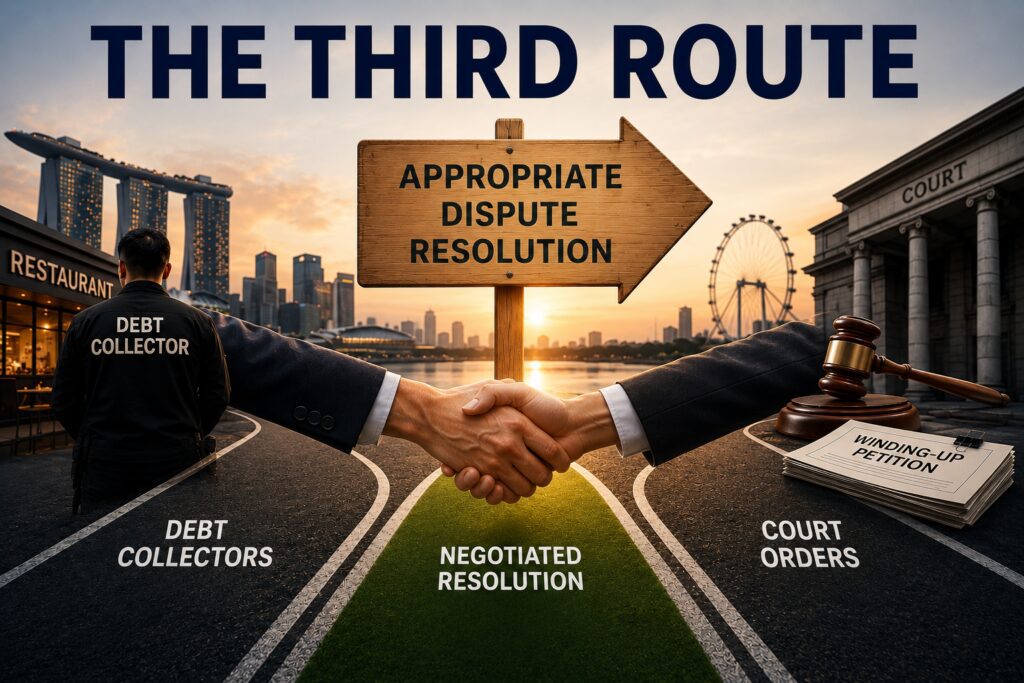
Between debt collection and court proceedings lies a third route: negotiated resolution, structured without-prejudice meetings, mediation, and debt restructuring. This route is not naive idealism. It is commercially pragmatic. And it is affordable even for SMEs.
The difference is this: debt collectors and court orders impose outcomes by force. Negotiated resolution allows parties to author their own solutions. Parties respect commitments they design themselves far more reliably than those imposed by courts.
Two real matters illustrate why this third route often yields better results than maximum escalation.
Case Study 1: Creditor Coordination and Restructuring
An F&B operator faced mounting pressure from multiple creditors: ingredients suppliers, equipment lessors, landlord. The operator had legitimate service issues with some suppliers. Cash flow was constrained. Insolvency loomed.
The suppliers faced a choice. They could escalate individually—send debt collectors, file winding-up petitions, grab what they could before other creditors did. Or they could coordinate.
They chose coordination.
Through a series of without-prejudice discussions, creditors recognised a simple economic fact: individual escalation reduces collective recovery. If one creditor destroys the restaurant by forcing it into formal insolvency, the others recover nothing. A formal insolvency process takes months and yields cents on the dollar.
But if the restaurant survives, all creditors get paid.
The creditors agreed to a bespoke restructuring arrangement: staged payments over 18 months, with priority given to ingredients suppliers (whose non-payment would kill the business immediately), followed by other claims. In exchange, each creditor agreed to suspend collection action.
Result: The restaurant remained operational. Creditors received staged payments over 18 months. The recovery exceeded what formal insolvency would have yielded. The cost was lower. The process was faster. Management distraction was minimised.
The outcome was possible because creditors prioritised collective solvency over individual maximisation.
No debt collectors. No court orders. No public litigation. No reputational damage. Just adults in a room, recognising they had aligned interests.
Case Study 2: Disputed Debt, Harassment Risk, and Structured Settlement
An alleged debtor faced collection agency action over a contested commercial debt. The underlying debt itself was disputed. The alleged debtor maintained the debt was contested on substantive grounds.
The collection agency did not accept this. They attended at the alleged debtor’s residential address on multiple occasions. They engaged family members in attempts to locate him. They persisted despite the alleged debtor issuing a cease and desist letter and making himself formally contactable through his lawyer.
The alleged debtor’s response was to commence proceedings under the Protection from Harassment Act.
Now the alleged creditor faced a different problem. They were no longer defending a debt claim. Their very appointed debt collector was defending a harassment allegation. The underlying debt remained disputed. The harassment court proceeding itself had become the immediate issue the alleged creditor needed to resolve.
The matter appeared headed for full litigation. But at a critical stage of the proceedings, the parties shifted toward negotiated resolution.
Rather than pressing for punitive outcomes, the claimant proposed an amicable resolution. The parties negotiated a structured settlement on a without admission of liability basis. The respondents agreed to provide undertakings not to attend at the claimant’s residence, family residence, or office premises. The scope was broader than what the Court would likely have ordered through a formal protection order. In exchange, the claimant waived costs and damages.
The matter was resolved without determining the underlying debt. No final judgment on liability. No damages award. But a practical, proportionate outcome that both parties could live with.
Why did the alleged creditor agree to this?
Because continuing to litigate meant:
- Defending harassment allegations
- Facing potential damages and costs orders
- Months of court hearings and submissions
- Reputational damage in a tight industry
- Uncertainty about the outcome
Why did the alleged debtor agree?
Because it removed the immediate pressure, created space for the underlying debt to be resolved later if needed, and avoided further escalation.
Voluntary compliance is more reliable than court order compliance.
This is the core insight. Both parties negotiated undertakings they could respect. They weren’t imposed by a judge. They were authored by the parties themselves. Compliance was therefore reliable in a way that a formal protection order might not have been.
The matter demonstrates how calibrated procedural pressure, combined with a willingness to negotiate, achieves practical outcomes more effectively than prolonged litigation. It also illustrates the legal risks debt collectors and alleged creditors face when collection conduct intersects with Singapore’s harassment laws, particularly where the underlying debt remains disputed.
The Problem with Debt Collectors: When Enforcement Becomes Liability
The ST article frames debt collection as a necessary evil. The reality is more complex.
Debt collectors are effective in narrow scenarios: undisputed debt, solvent debtor choosing not to pay, clear documentation. In these cases, a collector’s appearance creates compliance pressure without legal risk.
But debt collectors fail and create liability in several common scenarios.
Scenario 1: The Disputed Debt
If a debtor credibly disputes the debt, a debt collector’s attempts to collect face legal headwinds. The debtor may issue a cease and desist letter. The debtor may commence harassment proceedings. The collector’s continued pursuit of a disputed debt—particularly if it involves attendance at residential addresses or engagement with family members—risks crossing into harassment territory.
This is where Case Study 2 becomes instructive. The creditor, pursuing a disputed debt through physical attendance and family engagement, ended up defending harassment allegations instead of collecting money. The cost and risk profile inverted entirely.
Scenario 2: The Insolvent Debtor
If a restaurant is genuinely insolvent, a debt collector achieves nothing. The supplier would be ahead by pursuing formal insolvency. As Bryan Lian notes: “When the restaurant is bankrupt, there is nothing you can do.”
A debt collector cannot extract money from a restaurant with no cash. The supplier has sunk cost and remains unsecured.
Scenario 3: Procedural Vulnerabilities
Collection agencies, like the respondents in Case Study 2, sometimes fail to attend court hearings or comply with procedural directions. This creates vulnerabilities to default judgments, costs orders, and sanctions. The alleged debtor, who started in a weak position, can end up with leverage.
Scenario 4: The Harassment Exposure
A collector’s conduct triggering harassment claims exposes the supplier to defence costs, counterclaims, damages, and reputational damage. For small suppliers, this risk can exceed the debt’s value.
The question then becomes: was debt collection actually worth it?
Why Negotiation Works Better
The common thread in both case studies is this: parties chose negotiation over maximum escalation.
In Case Study 1, creditors recognised that coordinating restructuring was more valuable than individual collection. They structured without-prejudice discussions, agreed payment priorities, and achieved ongoing recovery.
In Case Study 2, the alleged creditor, facing harassment allegations and procedural vulnerabilities, recognised that continued litigation was more expensive and uncertain than negotiated settlement. They offered undertakings broader than what a court would order, and the alleged debtor accepted.
Both outcomes were superior to what either party would have achieved through full escalation.
The mechanics are straightforward:
Document the debt properly. For suppliers operating on credit terms, this means signed terms of trade, regular invoicing, and contemporaneous records of disputes. Without this, any enforcement—whether collection or court—is weak.
Screen and communicate early. When a restaurant signals distress (declining orders, late payments, evasive responses), initiate structured communication before engaging collectors. A conversation about payment restructuring can happen in weeks, not months.
Escalate only when necessary. Debt collection should be reserved for scenarios where the debt is undisputed and documented, the debtor is solvent, early communication has failed, and the debt is material enough to justify the cost and risk.
Use lawyers for leverage, not just escalation. A letter from a lawyer signals seriousness while preserving negotiation options. It places formal demand on record without immediately triggering collection agency involvement.
Coordinate with other creditors. If a debtor is struggling, suppliers are rarely alone. Informal creditor coordination (as in Case Study 1) often yields better outcomes than individual escalation. Creditors who coordinate achieve clearer information, leverage for restructuring, reduced duplication of costs, and a collective interest in the debtor’s survival.
Know your regulatory exposure. Before engaging a debt collector, understand what documentation is required, what conduct is prohibited, and what harassment liability exists.
The Regulatory Framework: Why It Matters
Singapore’s Debt Collection (General) Regulations 2023 impose mandatory constraints on how debt collectors operate. Understanding these constraints is essential because they expose creditors to liability when collectors breach them.
Documentation Requirements (Regulation 9)
A debt collector cannot act without a written agreement between the collection agency and the creditor. This agreement must specify the debt amount, debtor identity, and fees payable.
For informal suppliers, this creates a practical barrier. A supplier who extended credit via email confirmations or WhatsApp messages may struggle to evidence the debt properly.
Identity Verification (Regulation 14)
Before approaching a debtor, the collector must obtain the creditor’s loan agreement or document evidencing the debt, and verify the alleged debtor is actually the debtor.
The collector cannot proceed without this. Many informal supplier arrangements fail this test.
Prohibited Conduct (Regulation 16)
A debt collector must not use threatening words, behaviour, or communications whereby the victim is likely to believe unlawful violence will be used. The regulations specify: brandishing a fist, shouting threats of physical harm, sending SMS or app messages threatening physical injury.
These are red lines. Crossing them is an offence.
Harassment Law Intersection (Regulation 10)
A collection agency must ensure debt collectors do not breach the Protection from Harassment Act 2014 or the Penal Code. A creditor engaging a debt collector remains exposed to harassment claims if the collector’s conduct crosses into systematic intimidation, repeated contact despite objections, or implications of unlawful force—even if the underlying debt is valid.
Case Study 2 illustrates this intersection precisely: a creditor pursuing a disputed debt through physical attendance and family engagement triggered harassment allegations, transforming the matter from a debt claim into a harassment defence.
What This Means for the F&B Ecosystem
The ST reporting frames the F&B crisis as a binary: suppliers versus defaulting restaurants. This is incomplete.
Some escalation is necessary. Suppliers cannot absorb unlimited bad debt. But maximum escalation is not always optimal. Debt collection is expensive, legally constrained, and often ineffective against insolvent debtors. It also exposes suppliers to harassment liability.
The missing middle—negotiated resolution, structured communication, creditor coordination, mediation, debt restructuring—often yields superior outcomes.
Chief Justice Sundaresh Menon has articulated a shift toward “Appropriate Dispute Resolution”: selecting the most suitable mechanism for each dispute, not defaulting to litigation. This framing reorients commercial parties away from viewing debt collection and court orders as inevitable escalation paths.
For suppliers, the question should be: what mechanism actually resolves this dispute, protects my interests, and minimises collateral damage?
Often the answer is negotiation.
Conclusion
The best commercial outcomes are not those where one party crushes the other.
In a climate where F&B operators face genuine financial stress—cost inflation, changed consumer behaviour, structural market headwinds—a supplier’s decision to negotiate rather than escalate is commercial pragmatism.
A restaurant that survives and pays in stages yields more recovery than a restaurant that fails. Negotiated resolution costs less, takes less time, and creates less collateral damage than litigation or debt collection.
For suppliers considering a debt collector, work through this analysis:
- Is the debt documented and undisputed?
- Is the debtor solvent? If not, is formal insolvency more appropriate?
- Have early negotiation attempts been made and exhausted?
- Does the debt’s size justify the cost and regulatory risk?
- Do I have proper regulatory infrastructure in place?
If the answer to all five is yes, debt collection may be appropriate.
If the answer to any is no, the conversation with the debtor should come first.
This is not soft thinking. It is the hard logic of commercial law: maximise recovery, minimise cost, manage risk. In Singapore’s regulated debt collection environment, that logic increasingly points toward negotiated resolution as the first resort, not the last.
This article is published for general informational purposes only. It does not constitute legal advice and should not be relied upon as such. Nothing in this article creates or is intended to create a solicitor-client relationship between the reader and Omnia Law Chambers LLC or any of its lawyers. The content reflects general principles of Singapore law and does not constitute a legal opinion on any specific set of facts or circumstances. Readers who require advice on any legal matter should seek independent legal counsel.